
CHOOSE THE BEST PRODUCTS FOR TRAINING

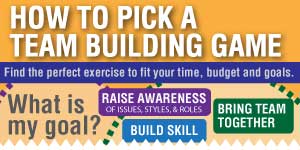
Get off to a good start with our trainer resources. Avoid dreaded icebreakers, pick the suitable game for every purpose, and use data to explain why playful learning works!
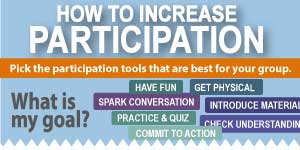
Give every participant ways to get up and learn with our classroom resources. Play competitive games that don't distract from your lessons, and chime in with an answer.
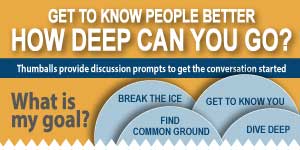
Find the perfect conversation prompts, whether you're meeting for the first time or diving into difficult conversations.
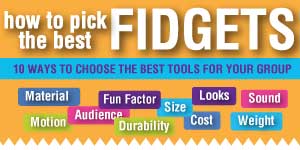
Understand the benefits of fidgeting using our trainer resources. Explain why "toys" are crucial, and choose the right ones for your group.
Reinforce learning with exercises and classroom resources that draw out "ah-ha" moments & encourage participants to commit to the next steps.

Learn the best ways to make your meetings enjoyable, memorable, and effective from expert facilitators.
FREE Advice!
- How should I break up a long presentation?
To break up a lengthy presentation and make your session more participatory, consider your material in terms of "Chunks." The goal of these classroom resources is to break up the session. They allow learners to take lots of breaks and increase participation. After all, most people can't focus for more than 20 minutes or so. Online, our attention spans are even shorter. Plus, beginnings and endings are more memorable, so you're wise to create lots of them! Consider adding these 5 approaches to your repertoire of trainer resources:
1) Introduce material
Instead of lecturing, ask questions and have learners think through the material before divulging answers.
- Quick Response Answer Boards allow every participant to think and jot down an answer. Have them raise their boards so you can quickly scan the room and get a sense of the group's understanding.
- Audience Response Clickers give every person a chance to guess an answer, usually A-B-C-D or True-False. With these, facilitators can tabulate results. If everyone knows an answer, they can move to the next topic. If not, they can take more time delving into the correct and incorrect answers. Sometimes false answers can lead to interesting conversations.
- Jeopardy games aren't just for reinforcement. They can be one of your trainer resources and a super fun way to introduce new information. By chunking their presentations into categories and questions, facilitators can help learners begin thinking about the material they've never been exposed to.
Flash cards aren't flashy, but they can be excellent classroom resources to activate the mind and body, as they can require writing, flipping, shuffling, sorting, walking, folding, etc.
2) CHECK understanding
Use tools that will allow EVERY participant to think of an answer, not just your fastest thinkers.
- Audience Response Systems (ARS) equip every participant with a clicker (or phone) so that players can key in responses. Many ARS are trainer resources best suited to multiple choice and true/false answers. Some do allow players to give more complex responses.
- If you prefer open-ended questions and free-thinking questions, rather than prompting the group with multiple-choice answers, try dry-erase Answer Boards. Find ready-made boards or create your own. A variety of dry-erase surfaces are readily available.
- Write it and Show it on Paper. If you don't have the time or budget to get fancy with classroom resources, plain old paper works well too, and can be recycled!
3) Get Physical & Have Fun!
If your goal is only to get people moving around, you may not need to tie the movement to the learning curriculum. One of your best trainer resources can be getting the blood moving to different parts of the body to positively impact learning.
- Move Your Body Thumball. Catch the ball and act out the movement described on the ball.
- Touchdown Learning. After one of the teams answers a question correctly, they stand up and advance their player with the appropriate "yardage."
- Tabletop Jeopardy. Have teams write questions for each other or come up and turn over a question card. It's more active than listening to a question read by a teacher, for sure!
- Prize Wheels. Spinning a prize wheel is one of the most fun trainer resources that can help groups pick questions, teams, categories, and prizes . . . or it can be a great excuse to get learners up and moving around. They can even spin to determine how many points they'll get if they answer a question correctly. Be creative!
- Scratch & See. For maximum movement, have players stand up and pick a custom-made card, then scratch away. Make-your-own scratch tickets can also be a classroom resource for prizes, team assignments, question categories, and more.
- Paper airplanes and paper balls. Rather than having learners raise a hand to ask a question, ask them to write it on paper, fold it into an airplane or squeeze it into a ball. These can be excellent trainer resources that learners can toss to someone else to read.
4) Practice and Quiz
Play quick-response games to improve memory and retention. Be warned, however, that you run the risk of leaving slower thinkers behind. Following are some tools that reward quick recall and ways to adapt them for including folks who need more time to think through their answer or feel shy about answering questions in a big group.
- Jeopardy game with Who's First or Me First buzzer. Game buzzers are trainer resources that add excitement to competitive games. Teams will race to buzz in and answer questions first. These classroom resources also help facilitators focus on the game content rather than defusing arguments about who gets to answer a question.
- Adaptation: to engage slower thinkers in the game, you might require every player on a team to come up with (or understand, or be able to explain) an answer before the team rings in.
- Toss and Recall games. Toss a ball or Koosh and have them remember a fact or answer a question.
- Adaptation: Recipients can also be trainer resources. Invite them to consult with someone next to them before sharing with the bigger group.
- Create-Your-Own Thumball / Beachball / (or Write and Toss Dice). Write questions or discussion prompts on the ball. Then, toss it and ask the recipient to respond to the prompt or answer the question under their thumb.
- Adaptation: have student teams write on the content reinforcement questions/prompts and see if they can stump one another.
- Adaptation: create three balls of varying difficulty.
5) Commit to Action
Use these classroom resources to ensure that learning is applied by asking participants to write down (and commit to) the next steps.
- Start-Stop-Continue-Change. At the end of a learning module, discuss the takeaways. This approach is one of the most effective trainer resources. You can ask the group what they'd like to START doing in the future, what they should STOP, and whether they want to CONTINUE or CHANGE other actions.
- What? So What? Now What? The focus of these questions is: What have you learned? So what is the significance of learning? Now, what are you going to do or change going forward?
6) Spark Conversation
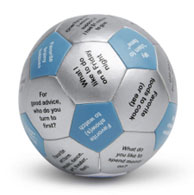
For some, coming up with stuff to say can be a daunting challenge. Various tools and trainer resources call on visual metaphors, quotes, or discussion prompts to spark creativity and the flow of new ideas. And they can be adapted to any topic in any discipline. Favorites include:
- Photo Decks are classroom resources that offer an array of thought-provoking images. Challenge your group to find an image that reminds them of an important fact or concept, or have them choose an image that reflects how they're thinking or feeling. Then they can discuss why they picked the image they did.
- Discussion Prompt Cards. On each card is an open-ended question. Pick a card as one of your trainer resources and ask someone else the question, or go ahead and answer it yourself. The facilitator can use discussion prompt activities to decide whether everyone should answer and discuss the same prompt. They can also let each person pick a different topic. Using the latter approach, you might cover more material but not dig in as deep or engage in rich dialogue.
- Thumballs. These require players to toss a ball, catch it, and respond to the prompt under their thumb. When using one of the trainer resources like this, consider how well the group knows each other and what sort of discussion topics would be welcome. Do you need to avoid uncomfortable silences? Get to know each other better? Or, dig into discussions about Stress, Diversity, Goals, Team Dynamics, etc.?